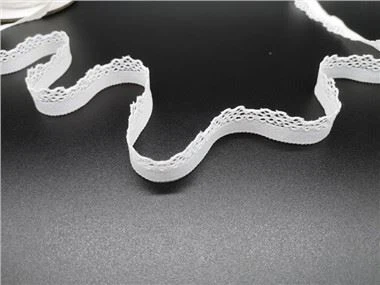
The Process Of Dyeing And Setting Lace
Apr 27, 2021
The change in the shrinkage of lace fabric is the phenomenon of fiber shrinkage caused by the weakening of the force between macromolecules in the fiber. This thermal contraction is irreversible, which is different from the "thermal expansion and contraction" phenomenon of general solid materials. Generally, only synthetic fibers have thermal shrinkage, and the force between the macromolecules of natural fibers and regenerated fibers is relatively large, and thermal shrinkage will not occur. The synthetic fiber is heated to a certain temperature, and the residual stress in the fiber during the production and molding will cause thermal shrinkage. The thermal shrinkage rate varies with the heat treatment conditions. The thermal shrinkage of synthetic fibers is not conducive to the wearability of the finished product. When the thermal shrinkage of the fibers is large, the dimensional stability of the fabric is poor. When the heat shrinkage of the fiber is uneven, the fabric will wrinkle and be uneven. When the synthetic fiber or its fabric is heated to above the glass transition temperature, the force between the macromolecules inside the fiber will decrease, and the fiber's deformability will increase. If a certain tension is added to force the fiber to deform, the shape of the synthetic fiber fabric will be stabilized under the new molecular arrangement after cooling and releasing the external force. As long as the temperature in use does not exceed the setting temperature, the shape of the fiber or fabric will not change greatly. This property of synthetic fibers is called thermoplasticity. The processing using the thermoplasticity of the fiber is called heat setting. Clothing ironing is a form of heat setting. Heat setting can also be carried out at a certain temperature and without tension. The fiber quickly relaxes and creeps to eliminate internal stress. After cooling, the stability of the size and shape of the fiber increases. This processing method is called relaxation heat setting. The main factors affecting the heat setting effect are temperature and time. Proper heat setting treatment will significantly improve the dimensional stability, elasticity and wrinkle resistance of lace. In the heat setting process, the synthetic fiber or its fabric is rapidly cooled after high temperature treatment, and the mutual position of the molecules within the fiber is quickly frozen and fixed, forming more amorphous areas, making the fiber or fabric feel softer and more elastic. After the garment is ironed and processed, it should be cooled as quickly as possible to obtain a good shape setting effect. If it is cooled slowly for a long time after high temperature treatment, the mutual position of the molecules inside the fiber cannot be fixed quickly. In addition to the disappearance of the deformation of the fiber and the fabric, it will also cause significant crystallization of the internal structure of the fiber, which will reduce the elasticity of the fabric and make the hand feel hard.
Synthetic fibers with high water absorption such as nylon may reduce the bonding force between the macromolecules of the fiber and accelerate the disconnection of the intermolecular bonding points, which is conducive to the heat setting effect. Therefore, the setting effect of steam or water boiling method is better. The effect of dry heat setting is better. Our normal dyeing is done by boiling. The lace and fabric look more perfect after setting.